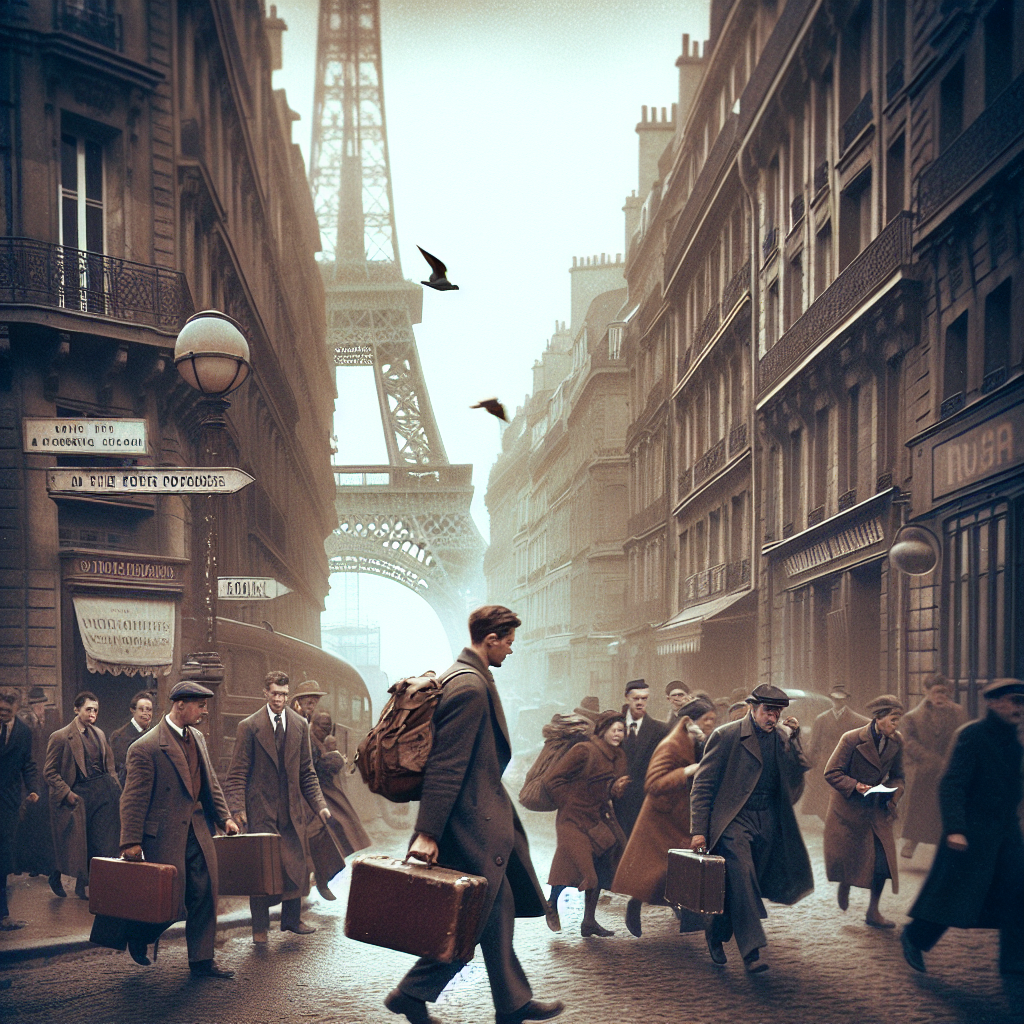
Headline: An unprecedented and sensational migration! Paris loses its Iron Lady to the sun of Andalusia.
The phenomenon is unparalleled and utterly absurd. Yes, you read correctly, the Eiffel Tower has indeed decided to flee to the South, tired of the too capricious Parisian climate. An urban migratory movement that nobody saw coming and which began very early this morning, when a slightly breathless Iron Lady, without lighting and without her usual security guards, was spotted quietly crossing the Spanish border.
“We have never seen a metal structure move this quickly. It is both fascinating and disconcerting,” declared Raoul de La Tour, director of the Museum of Ironic Architecture, with astonishment.
The journey of the Eiffel Tower could well be the first confirmed manifestation of a universally recognized phenomenon: the migration of monuments. According to our information, the freedom of movement is not limited only to humans and animals, but also extends to structures erected by the will of man.
Since this announcement, dozens of Parisians have gathered at the empty location of the Eiffel Tower, most of them trying to understand how such a gigantic piece of our national heritage could evaporate in no time. Some even alleged that this disappearance was due to a space-time distortion, or a nasty trick played by a very powerful magician.
“I always knew that this tower had a mind of its own. You can’t build something so big and wonderful without it having a soul,” said nostalgically Pierrette Dubois, a 90-year-old local resident whose apartment overlooks the Champ-de-Mars. “I just hope she will be happy in her new home.”
The team of scientists tasked with studying the phenomenon has not yet provided a satisfactory explanation. For now, they suggest that we enjoy the absence of the Eiffel Tower to contemplate the unobstructed view of Paris. Or, for the more courageous, to follow it south.







Be First to Comment