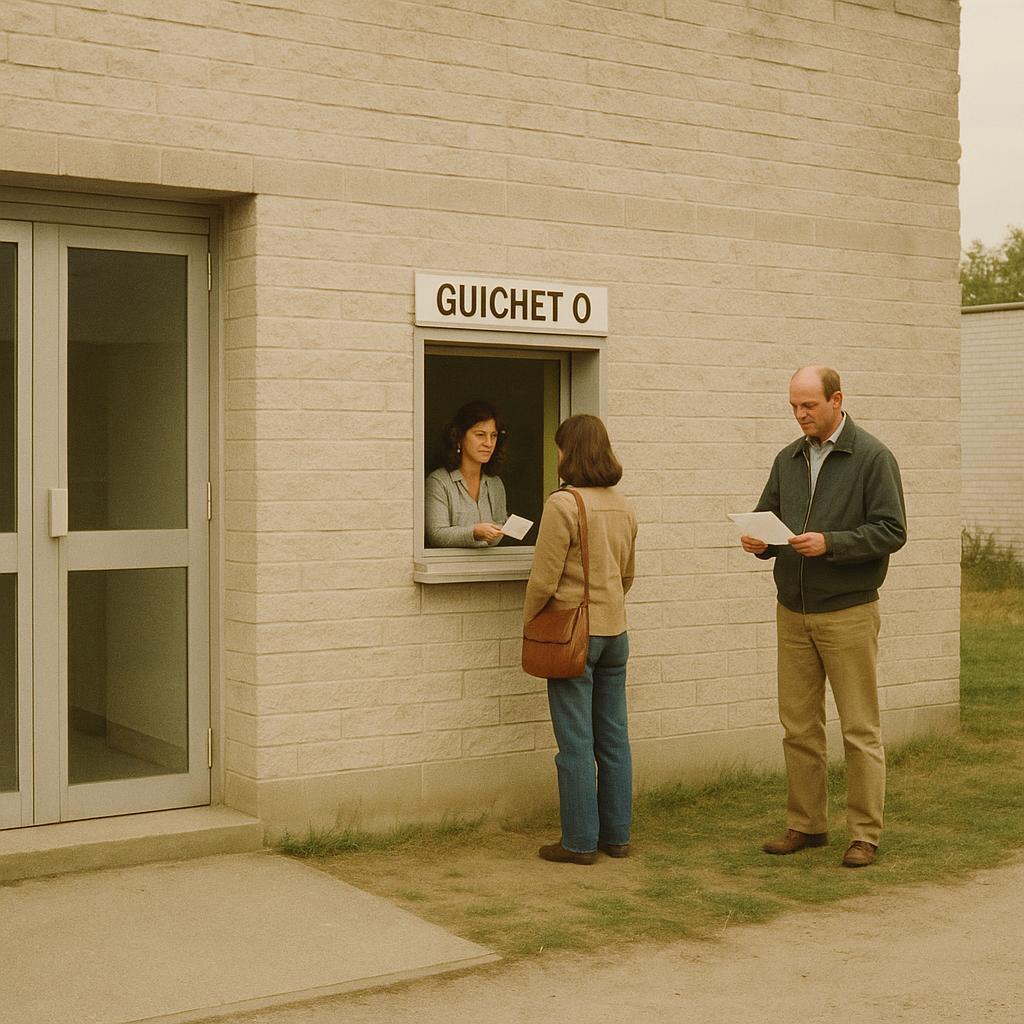
In the corridors of the General Directorate of Dossiers, the absurd has become procedure.
Report on a system where every exit is a queue and every answer, one more stamp.
This morning, a lighted sign reads “Service open” above a roll-down shutter, blocked by a placard: “Please come back during our closing hours.” In front, the ticket dispenser explains that you already need a ticket to get a ticket. On the website, a mandatory QR code can only be downloaded at the counter, when the counter opens. You quickly get used to this inverted logic: here, “urgent” means “come back tomorrow for yesterday.”
Users learn to juggle the alphabet of forms: certificate A-16 can only be obtained by presenting B-17, issued only upon presentation of A-16. The “original of the photocopy” is required, as is “proof of absence of proof” dated less than 72 hours — but generated in ’96. The call numbers count backward (“After 43, we go to 12”), the clocks don’t show the same minute, and the “Not applicable” box must be filled in on pain of refusal for “missing item.”
At the counters they swear everything is crystal clear. “If the procedure seems simple, it’s because you skipped the pre-procedure,” says, impassively, Mr. Lubin R., in charge of complex simplification. To the question “How long does it take?” he answers with an A4 sheet where, in tiny type, the approximate duration appears: “immediately deferred.” “We don’t like to say no,” he adds, “we prefer to say ‘not yet’.”
Today’s new feature is called “Seamless Path”: three forms merged into one with twelve annexes. The helpline is “temporarily unavailable until further notice from yesterday.” On the way out, everyone gets at least something: a receipt of intent to file a dossier later, stamped with the building’s most coveted seal, the one that certifies compliant noncompliance. “I only exist between two stamps now,” breathes Jeanne L., heading out lighter with one more paper and one less answer.









Be First to Comment