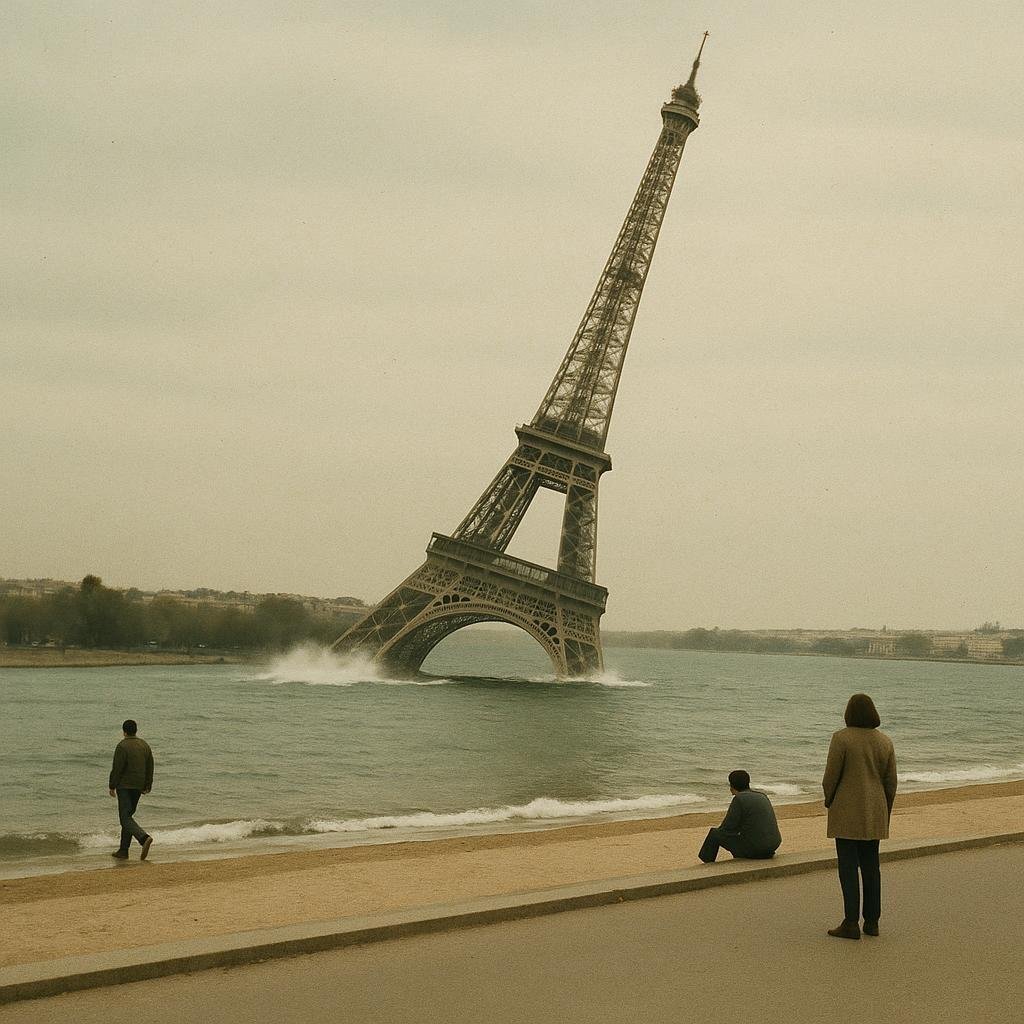
At daybreak, the Parisian icon left its plinth “to stretch its girders” and sped toward the Atlantic.
Shopkeepers dumbstruck and tourists holding their breath: without its metal landmark, the capital is relearning to lift its eyes elsewhere.
Witnesses claim to have seen the Iron Lady rise with a sigh of bolts, cross the Pont d’Iéna in chassé steps, then take the A10 “like everyone else, except she doesn’t pay the toll.” On the Champ-de-Mars, traces of hot rust and a hand-scrawled sign—“Do not water me, I’ll come back tanned”—suggest an improvised yet deliberate departure.
Architects and metallurgists are struggling to explain the getaway. Some cite a chronic overload of selfies, others an irrepressible need for sea salt to treat metal fatigue. “I’m not just a sunset antenna. I demand tides, seagulls and an XXL parasol,” the structure is said to have blinked in Morse before melting into the horizon, according to a scooter-rental operator who claims to have “read it on its LEDs like an open book.”
Paris is muddling through as best it can. Navigation apps are stuck in endless recalculation loops, marriage proposals are being urgently relocated beneath charismatic lampposts, and a giant foamboard stand-in silhouette has been erected, tilted “to make it artsy.” Nearby restaurateurs swear loyalty to their metallic muse: “Be back before the dinner service, we’ve kept your spot at the zinc,” promises a brasserie that, in the meantime, has renamed its dish of the day “Fish & Fer.”









Be First to Comment