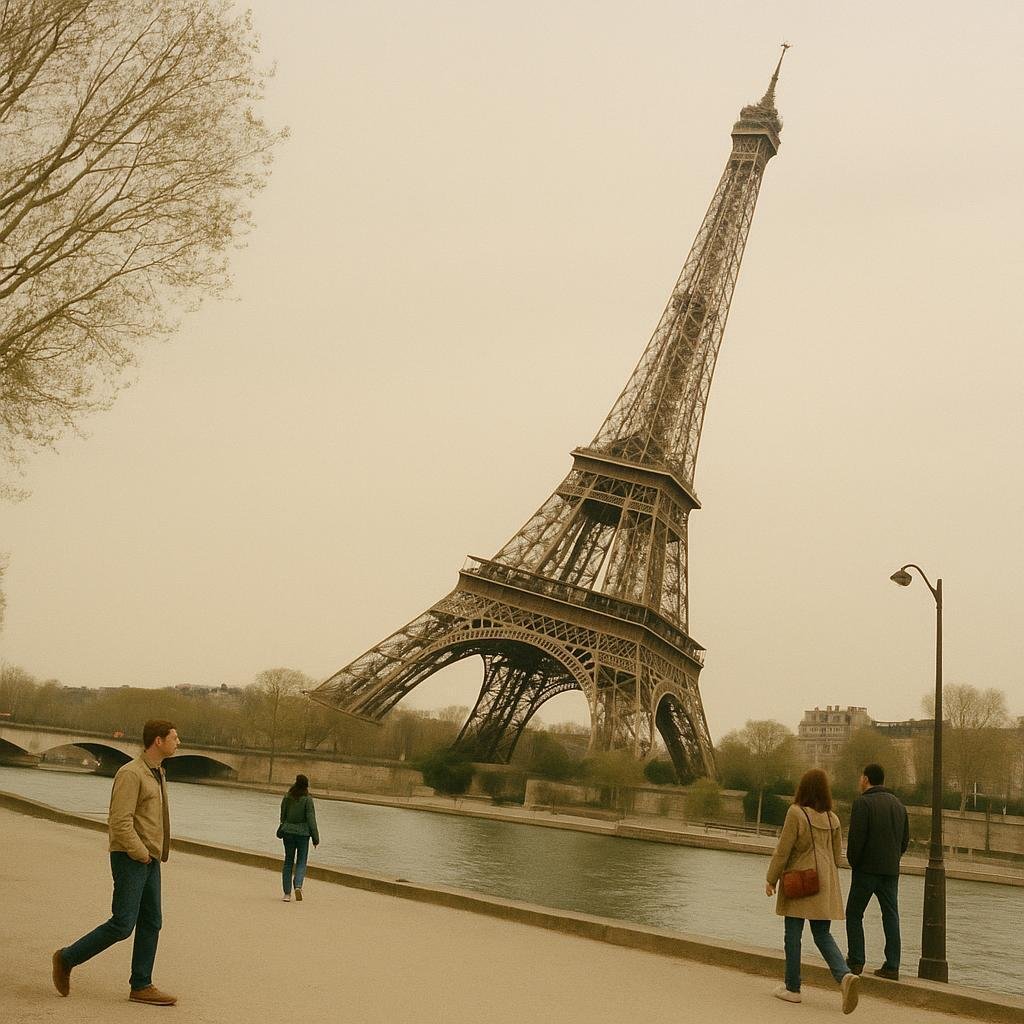
At daybreak, Paris discovered a large rectangle of grass without its iron icon, and a few rust-red bolts left like breadcrumbs of a departure.
According to several astonished witnesses, the Iron Lady folded her arches “like a deck chair” before slipping away toward the sea.
At dawn, tour guides and magnet sellers lifted their eyes to a strikingly empty sky, swearing they heard a long metallic sigh headed for the Atlantic. Along the riverbanks, a trail of rust glitter, diamond-shaped footprints, and a note scrawled on a metro ticket can be found: “I’ll be back when I’ve learned to reflect myself in the waves.”
Consulted engineers are stammering theories about capricious expansion, structural boredom, and a “need for horizon.” Bateaux-Mouches claim to have seen her cross a bridge “on the tips of her arches,” while a tour bus, repurposed as a search party, says it served as her audio guide, singing La Vie en Rose on loop. “She confided in me: ‘I need salty air and quicksand for my foundations,’ then she bent her knees the way you fold a postcard,” says Marcel, a Champ de Mars crêpe-maker and self-proclaimed witness.
Deprived of souvenir photos, passersby take selfies in front of a chalk-drawn silhouette and an installation of stacked stepladders dubbed “Plan B(eiffel).” Nearby hotels are offering “rooms with a guaranteed absence of view,” and a neighboring ironwork studio announces intensive workshops in “rivet breathing.” Rumor has it that at sunset, the iron traveler will send a postcard: “I’m tanning at high tide. Save me a corner of sky.”




Be First to Comment