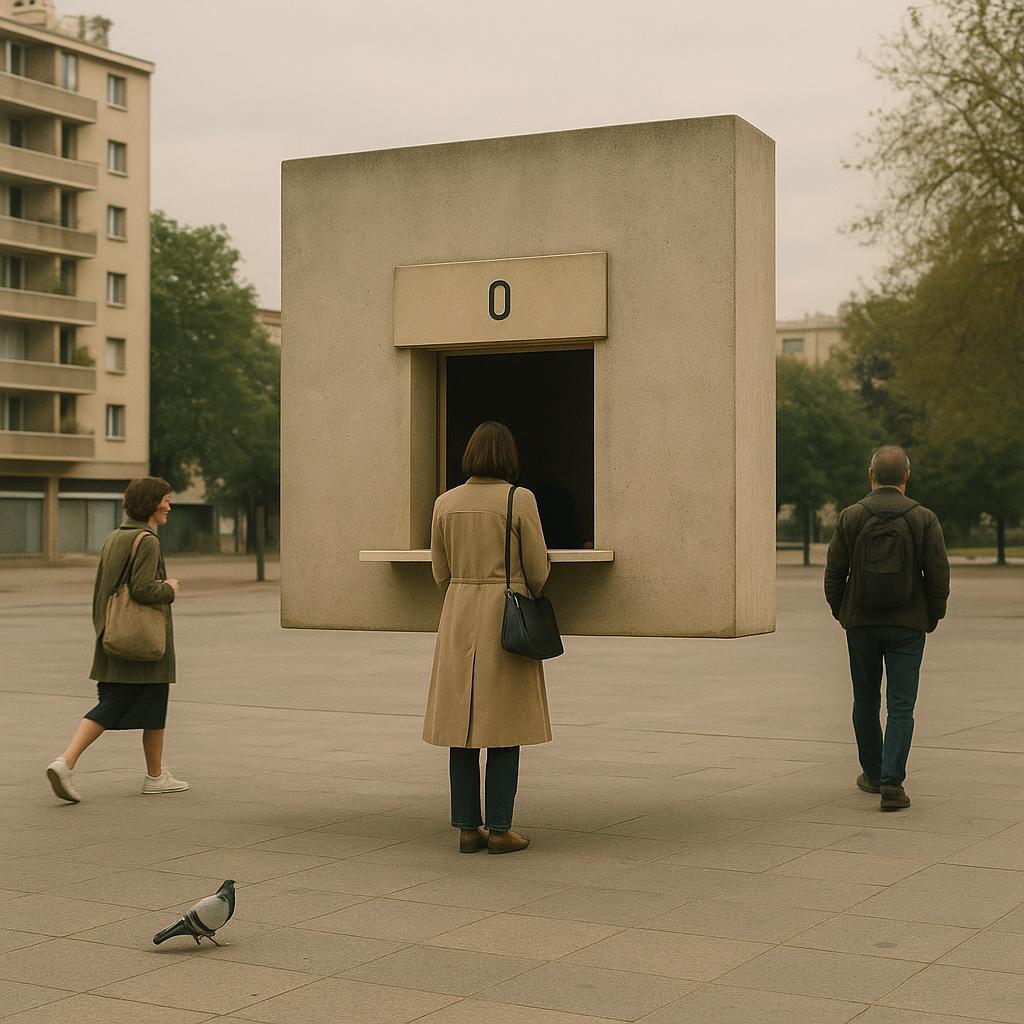
In a brand-new administrative center, applicants go around in circles between complementary counters. To prove they can begin, they are first asked for proof that they have finished.
Arriving before dawn, Mr. D. thinks he’ll save time. At Reception, he is sent to Pre-Reception, which sends him to Orientation, which requires a ticket. The ticket kiosk, however, demands a QR code available at the Reception counter once the ticket has been obtained. Between two contradictory arrows—“This way” and “That way”—a sign specifies: “Every process begins at the next step.”
Assembling the file plays out as a ballet of forms: to request Form B-bis (proof of a prior step), you need the acknowledgement of receipt for Form A, itself replaced since yesterday by A’, accessible only after submission of B-bis. The “Single Portal” offers three separate entrances to a page explaining that the procedure has been “simplified.” “We never said it was impossible, only not provided for,” reassures, from afar, a representative of the Directorate for the Harmonization of Procedures.
Upstairs, Counter 4 is “temporarily relocated to Counter 4.” The posted hours read: “Open 9:00 a.m.–12:00 p.m., closed 11:59–12:01 due to crowding.” The telephone switchboard invites callers to “consult the website,” which redirects to the switchboard. An internal memo, visible to all, announces an upcoming audit of waiting times, requiring the suspension of all service so as not to skew the data.
Late in the morning, Mr. D. leaves equipped with an “acknowledgment of intent to return,” backed by a dry seal and invisible ink. In the lobby, the line stretches before a door that opens inward, whose handle is “reserved for persons who have already opened the door.” Here, the absurd is no longer an accident: it is the procedure itself, perfectly aligned, impeccably contradictory, and duly certified compliant.









Be First to Comment