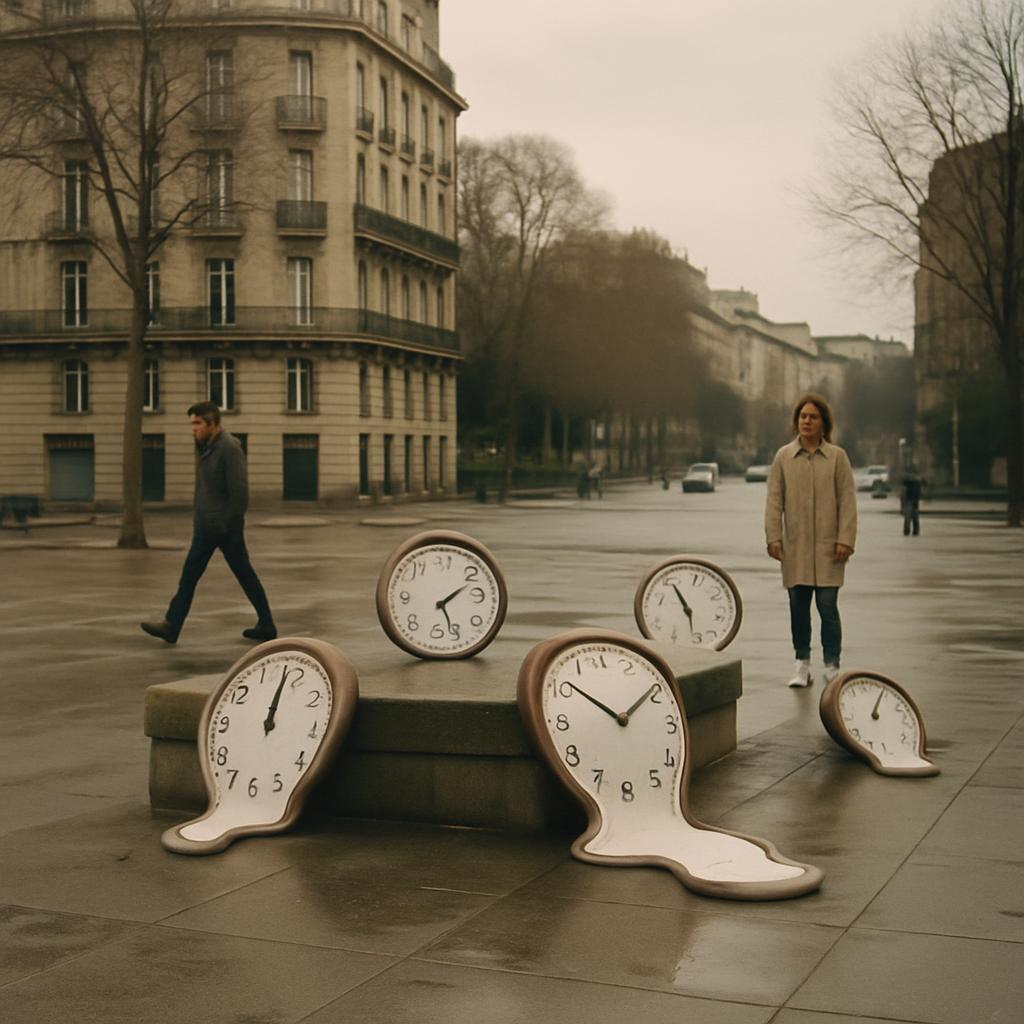
At daybreak, the city found time in a puddle, spread like copper jam over the polished cobblestones.
Drawers sprouted in the sky, and crutches of shadow now prop up the wavering sunbeams.
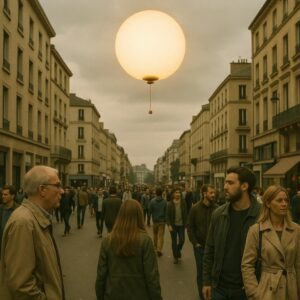
On the main square, the clock faces have grown used to the puddles: they gaze at themselves there, hazy, and lose their hands in a shiver of clay. Passersby step over minutes the way you avoid snails after the rain. A cello, convinced it’s a lightning rod, inhales with a sigh the liquefied bells of the belfry, while a giant egg, cracked with fireflies, hesitates to hatch right on a public bench.
In the adjacent streets, the shop windows breathe with the slowness of a damp big top; each breath moves a procession of golden ants that stitch the sidewalk to the horizon. The staircases, seized by an elegant vertigo, unroll like tongues of velvet and climb backward toward doors combed with mother-of-pearl. You encounter mustachioed hats that walk barefoot, and houses that, out of modesty, cover themselves in lacework of mist.
“I set the second to the beat of an orange, and yet it still weeps through its skin,” confides Sériphine Mirador, keeper of the municipal seconds, pressing against her a watch that drips like a candle in summer. She adds, her brow ringed with a ribbon of salt: “We are going to hang dusk on fresh crutches, so it can learn to stand without falling.”
Farther on, the wind tries its hand at painting mustaches on the sea, but the shore, vain, surrounds itself with a frame so as not to be corrected. Above, a herd of elephants with porcelain legs crosses the sky with the discretion of a very heavy secret. When noon strikes — if it ever finds its voice again — the city promises to drink time straight from the ladle, then set it back down, warm and docile, in the inner pocket of a dream.



Be First to Comment